
Edox
Brand History
Edox was founded in 1884 in Biel/Bienne by watchmaker Christian Ruefli-Flury, who chose for his manufacture a name derived from ancient Greek, linked to the idea of "measuring time": a direct nod to the watchmaker's craft itself, rather than to a particular figure or biographical episode. In 1900 the company adopted the hourglass as its symbol, still the brand's logo today, visually reinforcing that link to the passage of time. On the founder's death in 1921, leadership passed to Robert Kaufmann-Hug, who held it until 1965, when he was succeeded by Victor Flury-Liechti during a period of strong industrial expansion, with the manufacture growing to employ around 500 watchmakers.
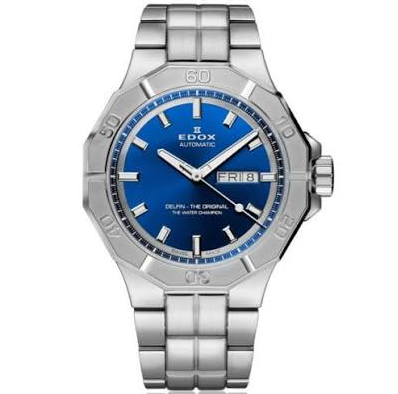
It is precisely in the 1960s that Edox built the identity that still defines it today: in 1961 it launched the Delfin, a dive watch that introduced a double-backed case and a novel gasket system — the "double O-ring" — capable of guaranteeing watertightness beyond 200 meters, a remarkable achievement for the time. The Delfin's success earned the brand the nickname, still claimed today, of "Water Champion" of Swiss watchmaking, and laid the groundwork for later developments such as the 1965 Hydro-Sub, able to reach 500 meters of water resistance thanks to a crown system with a tension ring.
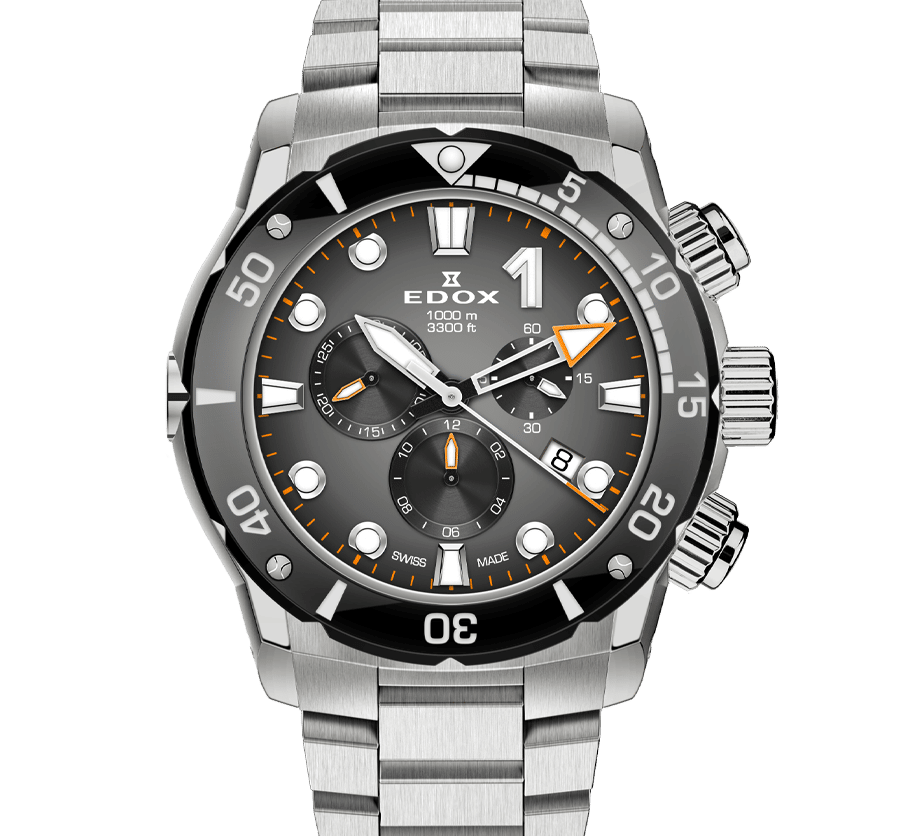
The quartz crisis of the 1970s hit Edox hard too, and in 1983 it was taken over by Victor Strambini and moved to Les Genevez, in the heart of the Swiss Jura, where it is still based today as an independent, family-run manufacture. From the late 2000s onward the brand added a motorsport soul alongside its diving vocation, becoming official timekeeper for competitions such as the Offshore Class-1 World Championship, the WRC, the Dakar and, more recently, entities such as BMW M Motorsport — a positioning that today coexists in the catalogue with collections more oriented toward sporty elegance.